
ADR: Ordered subagent model fallback
- Status: Accepted for implementation
- Date: 2026-09-14
- Related: ADR 0062, ADR 0063, ADR 0202, ADR subagent-model-opt-in
Context
A subagent can select only one model. Its existing bounded provider retries cannot recover when that model remains unavailable. Restarting the delegated task on another agent could repeat tools that already changed files.
Decision
Add optional fallbackModels to a definition, the user-subagent record/input, and the existing internal launch definition. It is an ordered list of provider/model strings in managed Markdown and host RPC, parsed into model pins in Shared. The existing primary model and Task override priority stay unchanged. Missing lists preserve single-model behavior. An omitted update preserves the list; [] clears it. No database or protocol version changes are needed for these additive fields; old documents remain valid.
Electron resolves alternatives through the same credential, provider-count, and model-capability boundaries as primary pins. These bindings are scoped to their owning definition, even when Task explicitly overrides its primary. They do not grant Task.model access to another definition, or enter the opted-in model summary. A primary pin that cannot resolve still fails before launch; an unresolved alternative is reported when reached and skipped.
After the current model's existing retries are exhausted (or a provider error is non-retryable), the runtime tries the next configured alternative. Each resolved provider-id/model-id pair is tried at most once per delegation, excluding the existing retry budget within each model. The same Agent keeps its system prompt, original task, successful assistant/tool history, tool scope, counters, and usage. Only the failed assistant request is removed from model context before continue(). It is retained in the visible transcript. No task or completed tool is replayed by the fallback controller.
The model, adapter, credentials, headers, output cap, and thinking level change together. Thinking is re-clamped from the definition or original parent selection for each model; omit remains omission. The original abort signal owns the whole chain. Host/tool failures, missing reports, unexpected thrown errors, and cancellation do not initiate fallback.
Failed attempts remain visible in child transcript diagnostics and in the bounded parent report. Lifecycle snapshots retain the final effective model, thinking, and additive modelFailures diagnostics. Exhausting the chain returns failed with the final provider error; it never selects an unlisted model or silently inherits the parent as recovery.
Settings example
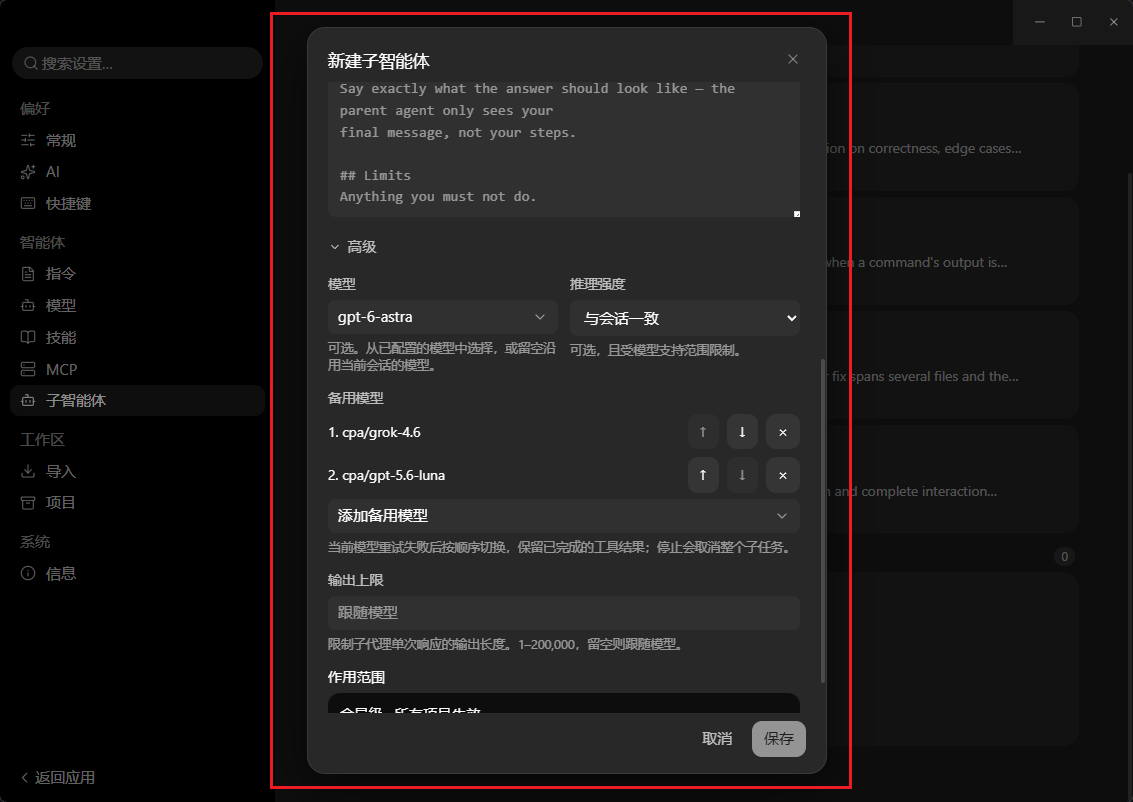
The Advanced section keeps one primary model and lists fallback models in priority order. Each fallback can be moved up/down or removed.
Validation
Shared parser and provider-resolution tests, host registry round trips, real local HTTP tests for continuation/credentials/cancellation, and the sidecar model suite cover the contract. Required integration suites are test:e2e, test:e2e:subagents, and test:e2e:subagent-models. The editor journey separately covers adding, reordering, removing, and retaining unavailable pins across save/reopen.
Local verification and remaining integration gates
- Runtime: 200 focused tests passed, including the existing parent-runtime suite; Shared: 35 definition tests; Desktop: 100 subagent tests; i18n: 24 tests; host-core: 13 subagent tests. Typecheck, lint, Rust formatting and clippy passed.
test:e2e:subagent-models: passed on the request branch with a real sidecar and local HTTP transport, including ordered fallback and live/settled model metadata. This is pre-integration evidence.test:e2e: 19 passed, two project-deletion assertions failed, and two live provider scenarios were skipped for missing credentials. An independently built, unchangeda9053531host reproduced the same two failures.- E2E: NOT RUN to completion for
test:e2e:subagentson Windows. Rust's known-folder lookup ignores the fixture HOME, so the suite now fails before registry writes. Alternative validation is the host record/document tests and Shared/launch-loader tests. The remaining risk is the complete managed registry RPC/save/reopen journey; run this suite under Linux/macOS isolation. - Full editor interaction/reload and post-integration
mainE2E remain outstanding. This request retains its branch and worktree for integration.
WSL branch verification (2026-09-14)
The implementation commit 82dfb3353ab071b4b0479ac401797cc6ab3c178f was exported to an isolated Linux filesystem directory and built under WSL2 Ubuntu 24.04, using Linux Node 24.14.1, pnpm 11.18.0, Rust 1.96.0, and Electron 43.6.0. No Windows node_modules or executable binaries were reused. The locked dependency install, JavaScript build, and Linux host build passed.
pnpm test:e2e:subagents: 31/31 passed, including ordered fallback persistence, omitted-update preservation, invalid-pin rejection, loader propagation, and clearing the list.pnpm test:e2e:subagent-models: 13/13 passed, including fallback and the existing model opt-in/override isolation scenarios.pnpm test:e2e: 21/21 non-live checks passed. The two real-provider cases (E2E-008-live-model,E2E-009-stream) were SKIPPED because no test API key was configured. Both project-deletion cases that failed on Windows passed on Linux; this does not fix or invalidate the Windows results.- An isolated Electron/Xvfb configuration-editor check using CDP passed four journeys: add/reorder/save, preserve across another-field edit and renderer reload, retain unavailable-provider pins, and remove all/save/reopen. The UI exercised the real renderer, preload, Main, and Linux host registry; persisted records were checked through IPC. It used synthetic providers without credentials and removed its temporary HOME/data/profile afterward.
The test environment set PI_DESKTOP_PLUGIN_MARKET_URL=http://127.0.0.1:9/e2e-offline-catalog so startup used the existing bundled marketplace catalog. With the default external market URL, WSL network connectivity caused host-handshake timeouts before the tested behavior. These runs do not qualify online marketplace connectivity. The UI run also logged an unrelated bundled pi.file-manager module-load error; its successful subagent assertions are not a full plugin health claim.
This closes the earlier Linux registry and configuration-editor validation gaps. Full task-transcript reload acceptance after fallback, real-provider cases, and required post-integration main E2E remain outstanding. No main integration or remote publication was performed during this validation.
Expanded failure-chain verification (2026-09-14)
The existing implementation at 82dfb335 was unchanged. Additional test sources were copied into the isolated WSL source snapshot; these results apply to that implementation with the expanded tests in this change.
| Local provider responses in configured order | Expected and observed result |
|---|---|
| Success, unused alternative | Primary completes; no alternative request |
| HTTP 404, success, unused alternative | Second model completes |
| HTTP 404, HTTP 404, success, unused alternative | Third model completes |
| HTTP 404, HTTP 404, HTTP 404, success, unused alternative | Fourth model completes |
| Four HTTP 404 responses | Child fails after four requests; no wraparound |
Both the real-transport runtime tests and the separate sidecar process passed this matrix. The sidecar assertions inspect actual request order, the original task, every live model change, the settled model/status, ordered failure codes, and the final child report. A successful parent response alone cannot pass the child-failure assertion.
Additional real-transport tests passed for mixed HTTP 401/403/404 failures, HTTP 429 and HTTP 503 exhausting independent retry budgets on two consecutive models, and preserving one completed tool call across one, two, or three failed models. The retry fixture sends Retry-After: 0; production retry logic and retry counts remain active, with no fake timers or retry bypass. Cancellation, unresolved/duplicate bindings, credentials, thinking selection, and host-tool error boundaries remain covered.
- Windows:
pnpm --filter @pi-desktop/agent-runtime exec vitest run src/subagent.test.ts src/subagent-fallback.test.ts src/subagent-definitions.test.ts src/runtime.test.ts— 210/210 passed. - Windows:
pnpm --filter @pi-desktop/agent-runtime typecheck— passed. - Windows:
pnpm lintandgit diff --check— passed. - WSL:
pnpm --filter @pi-desktop/agent-runtime exec vitest run src/subagent-fallback.test.ts --reporter=verbose— 17/17 passed. - WSL:
pnpm test:e2e:subagent-models— 17/17 checks passed, including five failure-chain/control scenarios and the existing model-isolation checks.
These are deterministic local HTTP providers driving the real runtime and sidecar, not live commercial-model availability tests. No application code changed, so the previously built portable executable contains the same tested fallback implementation. Main integration, post-integration E2E, live-provider coverage, and task-transcript reload acceptance remain outside this result.